 Mochi Isle
 Peat and carbon · Reed WetlandScience for kids
How does peat store carbon?
In short: In waterlogged wetlands with little oxygen, dead plants rot very slowly and build up in layers, forming carbon-rich peat. If a peatland is drained, air gets in, the plant remains break down faster and the stored carbon escapes.
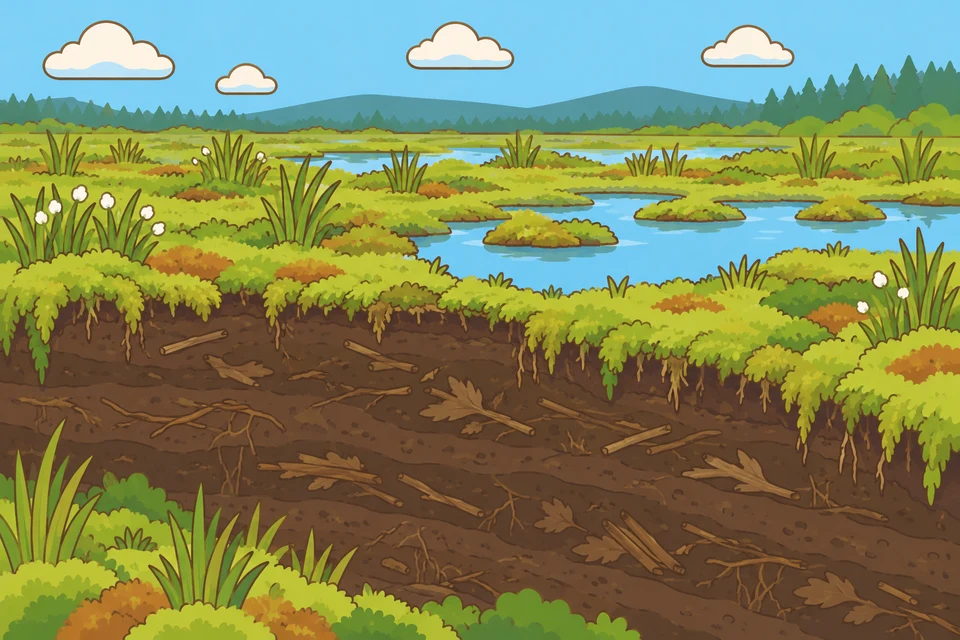
How it works
Leaves fallen in a garden rot away within months because decomposers, such as bacteria and fungi, are busy eating them. Decomposers need oxygen to work quickly. In a peatland, though, the ground is soaked with water, so little oxygen gets in and the decomposers work very slowly.
So when mosses, grasses and other plants die, they do not fully rot. They pile up, layer upon layer, and slowly turn into soft, dark-brown peat. Peat builds up very slowly, often only a thin layer a year, so a deep peatland can take thousands of years to form.
Growing plants take carbon dioxide from the air and store the carbon in their bodies. When they become peat, that carbon is locked underground. Drain a peatland and air gets in, decomposers start working again and the carbon returns to the air as carbon dioxide. Dry peat can even burn.
Where to see it in New Zealand
Kopuatai Peat Dome in the Waikato is one of New Zealand's largest and best-preserved raised peat bogs, and an internationally important wetland. Many Waikato farms were once peatland too. Since being drained, the peat has slowly broken down and shrunk, and in some places the ground is gradually sinking.
Try it together
Garden centres sell dried sphagnum moss, a kind of peat moss. Wearing gardening gloves, weigh a handful on a kitchen scale, soak it in water for ten minutes, drain it gently and weigh it again. See how much water it holds. Wash your hands afterwards.
Kids also ask
Is peat the same as ordinary soil?
No. Ordinary soil is mostly crumbs of rock, sand and clay. Peat is mostly plant remains that have not fully rotted, so it is light, soft, very wet and dark brown or black.
Why are peat fires so hard to put out?
Dry peat is full of plant material that can burn. A fire can creep underground and smoulder slowly, so even when the surface looks out, it may keep burning below for a long time.
What do peatlands have to do with climate?
Peatlands lock away huge amounts of carbon. Kept wet, the carbon stays put. Once they are drained or burned, it enters the air as carbon dioxide, which adds to global warming.
In the game, “Peat and carbon” is a nature card on Reed Wetland.
Your child finds this card by reaching the right place or meeting the right weather on the island, and lights it up by answering the question on the back. Tap the button below and the game shows your child which island it is on and how to find it. Mochi Isle is a browser learning game for ages 5 to 18; the main island and the daily lesson are free.
Find “Peat and carbon” on the island ↗ All cards from Reed Wetland