 Mochi Isle
 River deltas · Reed WetlandScience for kids
How does a river delta form?
In short: When a river carrying mud and sand reaches the sea or a lake, it slows down and drops its load. The sediment piles up and splits the river into several channels, slowly building a fan-shaped area of new land called a delta.
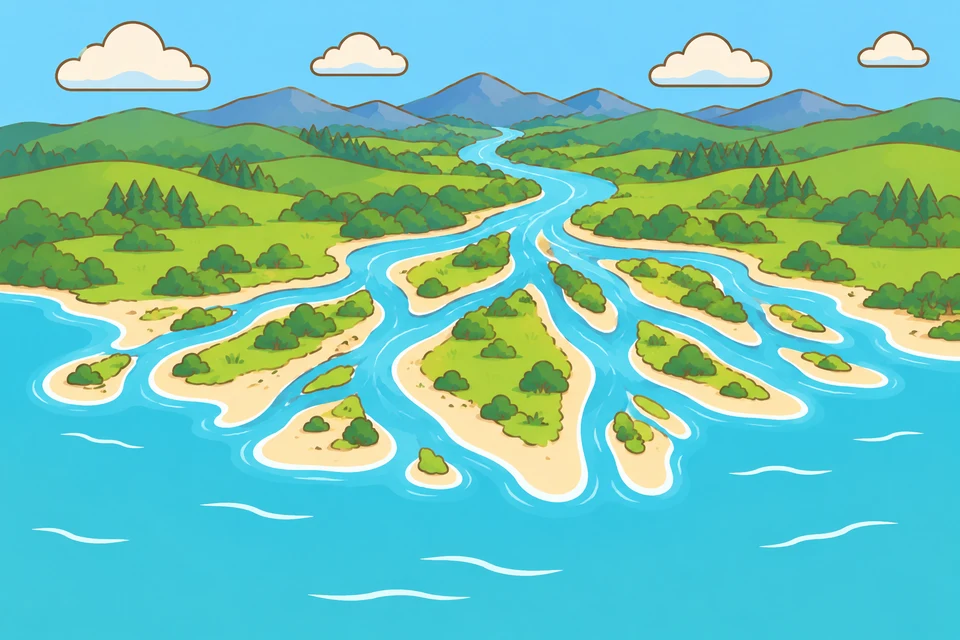
How it works
A fast river is like a speeding delivery truck that can carry lots of sediment, meaning sand, silt and mud. At the river mouth it flows into wide, calm water and suddenly slows. Now it cannot carry its load, so it drops it: coarse sand first, fine mud further out.
The dropped sediment builds up into sandbanks that block the old channel. The water has to go around them, splitting into two, three or many smaller channels. Each new channel drops sediment at its own mouth and splits again, so the delta branches out like a tree.
Ancient Greeks thought the land at the mouth of the Nile was shaped like their letter delta, a triangle, and the name stuck. Delta land is flat and fertile, which is great for farming, but it is low-lying, so it floods easily and is at risk from the sea.
Where to see it in New Zealand
New Zealand's deltas are mostly small but easy to find. Where the Tongariro River flows into the southern end of Lake Taupō, it has built a delta of wetlands and channels. In the South Island, the Clutha River splits into two branches before reaching the sea, with a large island called Inch Clutha between them. You can spot both on a satellite map.
Try it together
With an adult, in a sandpit or at the beach well away from the waves, dig a small channel leading to a shallow puddle. Slowly pour muddy, sandy water into the top end and watch how sediment piles up at the mouth and the water splits into streams.
Kids also ask
Does every river have a delta?
No. If waves and tides at the river mouth are strong, they sweep the sediment away before it can build up, and some rivers carry very little sediment. These rivers usually end in a wide, funnel-shaped estuary instead.
What are some famous deltas?
The Nile Delta in Egypt, the Mississippi Delta in the United States, which is shaped like a bird's foot, and the Ganges-Brahmaputra Delta in Bangladesh and India are among the best-known big deltas.
Do deltas keep growing forever?
Not always. If dams upstream trap sediment, less reaches the delta, and waves can slowly wear it away. A delta's shape is always changing as the river shifts and the sea pushes back.
In the game, “River deltas” is a nature card on Reed Wetland.
Your child finds this card by reaching the right place or meeting the right weather on the island, and lights it up by answering the question on the back. Tap the button below and the game shows your child which island it is on and how to find it. Mochi Isle is a browser learning game for ages 5 to 18; the main island and the daily lesson are free.
Find “River deltas” on the island ↗ All cards from Reed Wetland