 Mochi Isle
 Natural auroras · Aurora IcefieldScience for kids
What causes the aurora?
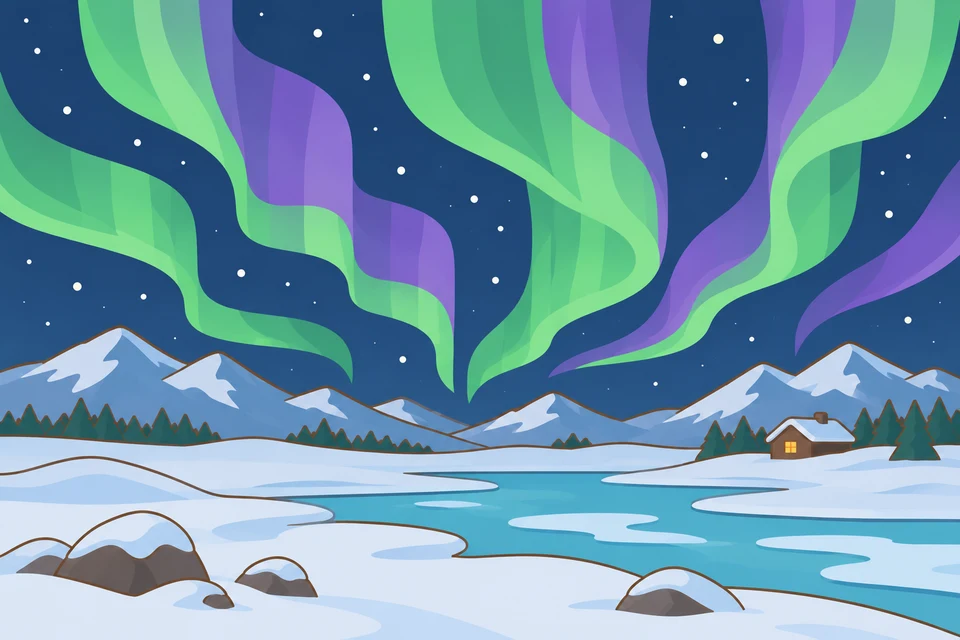
In short: An aurora is light made when charged particles from the Sun crash into the air high above Earth, making oxygen and nitrogen glow. Earth's magnetic field steers the particles towards the polar regions, so auroras are seen mostly at high latitudes.
How it works
The Sun constantly blows out an invisible stream of tiny charged particles called the solar wind. Earth is wrapped in a magnetic field that acts like an invisible umbrella. It keeps most particles away but guides some of them down into the sky around the North and South Poles.
The particles race into the air about 100 kilometres up or higher and hand their energy to oxygen and nitrogen, which then give off light, a bit like the gas in a neon sign. Oxygen usually glows green, oxygen higher up glows red, and nitrogen adds blue and purple.
When the Sun is very active and sends out a solar storm, auroras grow brighter and spread further from the poles. In the north they are called the aurora borealis, and in the south the aurora australis. Research stations only watch and measure auroras; nature makes them on its own.
Where to see it in New Zealand
New Zealand is one of the best places to see the aurora australis, especially Southland and Stewart Island / Rakiura, a Māori name often translated as 'glowing skies'. The dark skies around Lake Tekapo (Takapō in Māori) are great too. During very strong solar storms, auroras have been seen as far north as the North Island.
Try it together
When an aurora forecast looks promising, go with an adult on a clear night to a safe spot away from streetlights and look south. Faint auroras often look greyish to our eyes, but a phone camera's night mode can show the colours clearly.
Kids also ask
Why are most auroras green?
At the height where auroras are most common, oxygen glows green when it is hit, and our eyes are especially good at seeing green. Red and blue-purple auroras happen too, but they are usually rarer or fainter.
Are auroras dangerous?
Watching from the ground is safe, because the thick atmosphere protects us. Very strong solar storms can disrupt satellites, radio and power networks, though, so scientists keep a close watch on the Sun.
Can auroras be predicted?
Roughly. Satellites watch the Sun, and when a solar storm is spotted, forecasters can estimate a day or two ahead how strong auroras might be. The exact timing and brightness are still hard to pin down.
In the game, “Natural auroras” is a nature card on Aurora Icefield.
Your child finds this card by reaching the right place or meeting the right weather on the island, and lights it up by answering the question on the back. Tap the button below and the game shows your child which island it is on and how to find it. Mochi Isle is a browser learning game for ages 5 to 18; the main island and the daily lesson are free.
Find “Natural auroras” on the island ↗ All cards from Aurora Icefield