 Mochi Isle
 Earth’s axial tilt · Aurora IcefieldScience for kids
Why does Earth have seasons?
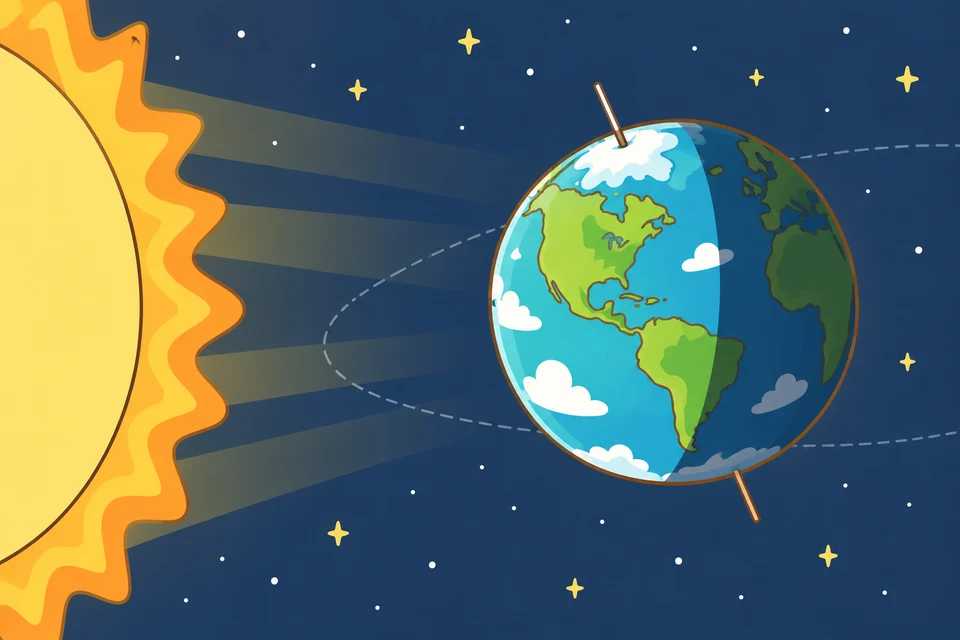
In short: Because Earth's axis is tilted. As Earth travels around the Sun, the two hemispheres take turns leaning towards it. The half leaning towards the Sun gets a higher Sun, longer days and stronger sunlight, which is summer; the other half has winter.
How it works
Earth's axis is tilted by about 23.5 degrees and keeps pointing the same way in space all year. As Earth travels around the Sun, sometimes the Southern Hemisphere leans towards the Sun and sometimes the Northern Hemisphere does, so the two halves have opposite seasons.
Shine a torch straight down on a table and you get a small, bright spot. Tilt the torch and the spot grows bigger and dimmer, because the same light is spread over more area. In summer the Sun is high and its light is concentrated; in winter it is low and the light is spread thin.
Many people think summer happens because Earth is closer to the Sun, but that is not true. Earth is actually closest to the Sun in early January, during the Northern Hemisphere's winter. The seasons depend mainly on the angle of sunlight and the length of the day.
Where to see it in New Zealand
New Zealand is in the Southern Hemisphere, so our seasons are the opposite of the Northern Hemisphere's: Christmas falls in summer, and the shortest days come around June. Matariki, the Māori New Year, is marked in midwinter when the Matariki star cluster, also called the Pleiades, reappears in the dawn sky, and it is now a public holiday.
Try it together
On a sunny day around midday, stand a stick upright outside, or use your own shadow, and measure how long the shadow is. Write down the date and measure again at the same time each month. Winter shadows are long; summer shadows are short. Never look straight at the Sun.
Kids also ask
Is it summer because Earth is closer to the Sun?
No. Earth is closest to the Sun in early January, when New Zealand has summer but the Northern Hemisphere has winter. If distance caused the seasons, both halves of the world would have summer at once.
Does Earth's tilt ever change?
Yes, but extremely slowly, over tens of thousands of years. For the whole of our lifetime, you can think of the tilt as fixed.
Why don't places near the equator have strong seasons?
Near the equator, the Sun is fairly high all year and day length barely changes, so temperatures stay similar. People there usually talk about wet and dry seasons instead.
In the game, “Earth’s axial tilt” is a nature card on Aurora Icefield.
Your child finds this card by reaching the right place or meeting the right weather on the island, and lights it up by answering the question on the back. Tap the button below and the game shows your child which island it is on and how to find it. Mochi Isle is a browser learning game for ages 5 to 18; the main island and the daily lesson are free.
Find “Earth’s axial tilt” on the island ↗ All cards from Aurora Icefield