 Mochi Isle
 Polar day and night · Aurora IcefieldScience for kids
Why do the poles have polar day and polar night?
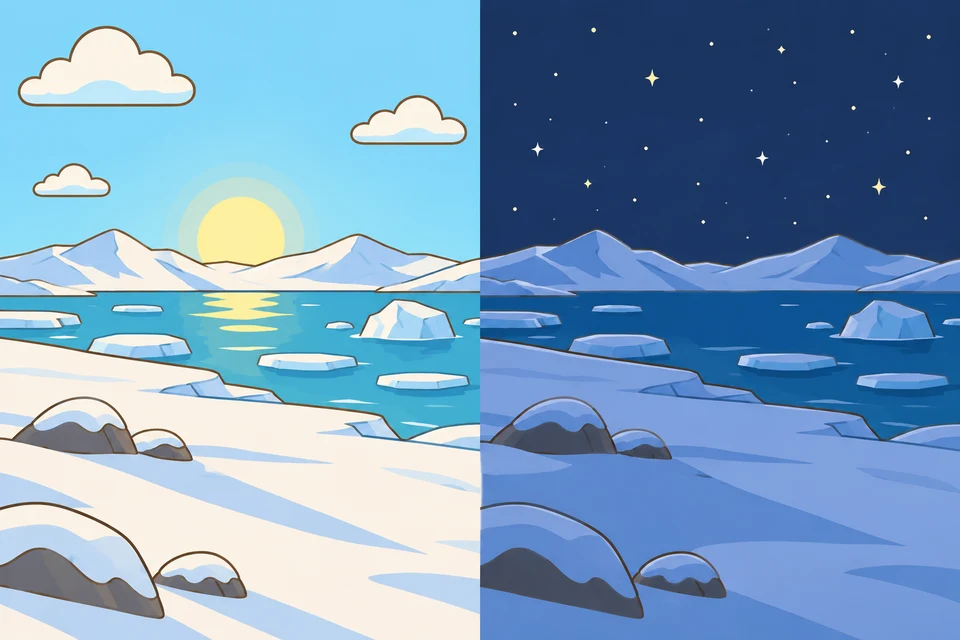
In short: Because Earth's axis is tilted. As Earth travels around the Sun, places near the poles stay facing the Sun for weeks or months, so the Sun never sets: polar day. In the opposite season they stay turned away, and the Sun never rises: polar night.
How it works
Earth spins like a tilted top. Its axis leans about 23.5 degrees and always points the same way in space. So as Earth travels around the Sun, for half the year the North Pole leans towards the Sun, and for the other half the South Pole does.
While the North Pole leans sunwards, places near it stay on the sunny side even as Earth spins right round. The Sun just circles the sky without setting. This is polar day, sometimes called the midnight sun. At the same time, the area around the South Pole is in long polar night.
The closer to a pole, the longer polar day and night last. On the Arctic and Antarctic Circles there is at least one day a year when the Sun does not set and one when it does not rise. At the poles themselves, there are roughly six months of light and six of darkness. Even polar night is not always pitch black: near its edges, the sky brightens with twilight around midday.
Where to see it in New Zealand
New Zealand is far from the Antarctic Circle, so we never get polar day or night. But the further south you go, the longer summer days become, so summer evenings stay light later in Invercargill than in Auckland. At Scott Base, New Zealand's station on Ross Island in Antarctica, winter brings months of polar night.
Try it together
Use an orange as Earth, with stickers at the top and bottom for the poles. In a dim room, ask an adult to shine a torch as the Sun. Hold the orange tilted, spin it slowly and walk it around the torch. Which pole stays lit?
Kids also ask
Do both poles have polar day at the same time?
No, it is the opposite. When the Arctic has polar day, Antarctica has polar night, and six months later they swap. So while the Northern Hemisphere has summer, Antarctica is in its long, dark winter.
Is polar night completely dark all day?
Not always. Near the Arctic and Antarctic Circles the Sun stays below the horizon, but around midday the sky glows with twilight, like the time just before sunrise. Only near the poles in deep winter is it almost fully dark.
In the game, “Polar day and night” is a nature card on Aurora Icefield.
Your child finds this card by reaching the right place or meeting the right weather on the island, and lights it up by answering the question on the back. Tap the button below and the game shows your child which island it is on and how to find it. Mochi Isle is a browser learning game for ages 5 to 18; the main island and the daily lesson are free.
Find “Polar day and night” on the island ↗ All cards from Aurora Icefield