 Mochi Isle
 Whale migration · Coral UnderseaScience for kids
Why do whales travel such long distances?
In short: Many whales migrate between cold feeding waters and warm breeding waters. They feast in food-rich cold seas in summer, then swim to warm, calm waters in winter to have their calves. Routes and habits vary by species.
How it works
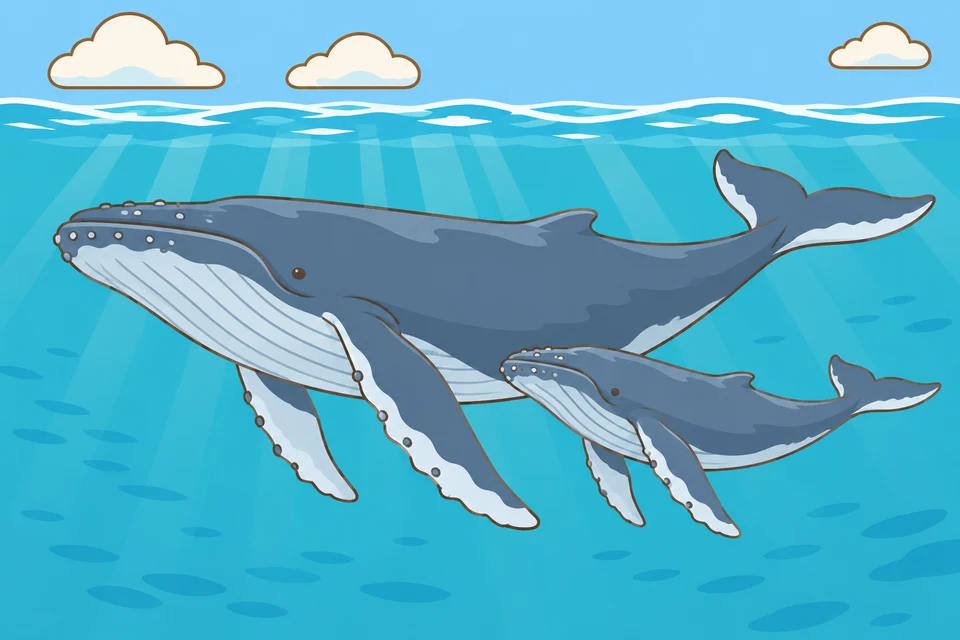
Baleen whales such as humpbacks spend summer feeding near Antarctica on krill, small shrimp-like animals that drift in huge swarms. Long summer days there make the sea burst with tiny life, and the whales build up a thick layer of fat called blubber.
In winter they head to warm tropical waters to mate and give birth. Newborn calves have thin blubber, so warm water helps them stay warm, and the seas there are often calmer. During the journey, many whales eat very little and live mostly off their stored fat.
Not every whale migrates, and routes differ by species. Some follow similar paths year after year, while others stay around one region. Scientists are still studying how whales navigate; clues may include Earth's magnetic field, the Sun's position and routes calves learn from their mothers.
Where to see it in New Zealand
Each winter, humpback whales travel north along New Zealand's coast towards warm waters around Pacific islands such as Tonga, and they are seen passing through Cook Strait and off Kaikōura. Kaikōura is also famous for sperm whales seen all year round, thanks to a deep undersea canyon rich in food.
Try it together
On a globe or world map, find Antarctica, New Zealand and Tonga. Stretch a piece of string from Antarctica past New Zealand to Tonga to see how far a humpback swims. Then think: if it barely eats on the way, what keeps it going?
Kids also ask
Do all whales migrate?
No. Many large baleen whales make long journeys, but some whales spend most of their time in one area. At Kaikōura, for example, sperm whales can be seen all year, feeding in the deep canyon nearby.
How do whales find their way?
Scientists have not fully worked it out. Whales may use clues such as Earth's magnetic field, the Sun's position, the shape of the sea floor and water temperature, and calves probably learn routes by travelling with their mothers.
In the game, “Whale migration” is a nature card on Coral Undersea.
Your child finds this card by reaching the right place or meeting the right weather on the island, and lights it up by answering the question on the back. Tap the button below and the game shows your child which island it is on and how to find it. Mochi Isle is a browser learning game for ages 5 to 18; the main island and the daily lesson are free.
Find “Whale migration” on the island ↗ All cards from Coral Undersea