 Mochi Isle
 Ocean currents · Coral UnderseaScience for kids
What makes ocean water move in currents?
In short: Large ocean currents are driven mainly by wind, by differences in water density (how heavy water is, depending on its temperature and saltiness) and by Earth's rotation. Slow patches and swirling eddies also form locally.
How it works
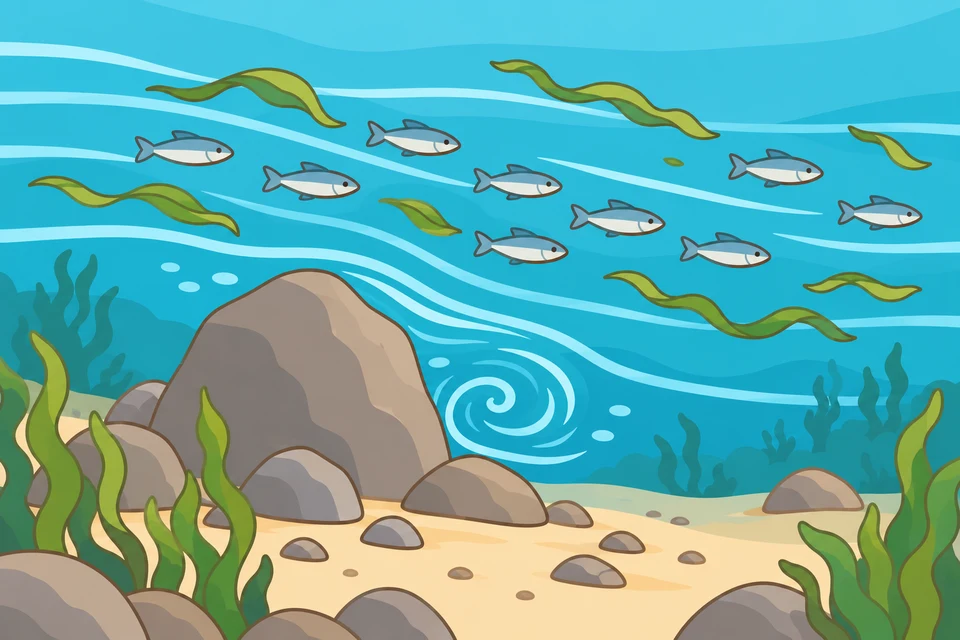
Surface currents are mostly pushed by the wind. Winds that blow the same way for months push the sea along, like blowing steadily across a bowl of soup. Because Earth spins, currents are gently turned, to the left in the Southern Hemisphere and to the right in the Northern Hemisphere, forming huge loops called gyres.
Deep in the ocean there is another kind of flow. Cold, salty water is heavier, so it sinks and creeps along the sea floor, while warmer or fresher water stays on top. These differences drive a slow 'conveyor belt' of water that loops around the whole planet.
Currents act like highways in the sea, carrying heat from the tropics to cooler places and moving nutrients, fish eggs and tiny creatures. Along the edges of big currents, swirling eddies spin off, and some areas have very little movement at all.
Where to see it in New Zealand
The East Auckland Current carries warm water from the north down the North Island's north-east coast, which is why divers at the Poor Knights Islands can see subtropical fish from warmer seas. Further south, the Antarctic Circumpolar Current flows all the way around Antarctica.
Try it together
Fill a clear container with warm tap water, not hot. Gently add an ice cube coloured with a drop of food colouring. Watch from the side: does the cold meltwater sink like a colourful waterfall and spread along the bottom? That is a density-driven current.
Kids also ask
Do currents carry rubbish?
Yes. Floating plastic can travel huge distances and often collects in the slow middle of the big ocean gyres. The North Pacific has a well-known patch like this. That is why rubbish must never go into the sea.
What is a rip current?
A rip is a narrow, fast flow of water heading from the beach out to sea. If you are caught, do not fight it: relax and float, raise your hand for help, and ride the rip until it weakens, then swim back to shore. Always swim between the flags.
In the game, “Ocean currents” is a nature card on Coral Undersea.
Your child finds this card by reaching the right place or meeting the right weather on the island, and lights it up by answering the question on the back. Tap the button below and the game shows your child which island it is on and how to find it. Mochi Isle is a browser learning game for ages 5 to 18; the main island and the daily lesson are free.
Find “Ocean currents” on the island ↗ All cards from Coral Undersea