 Mochi Isle
 Light at depth · Coral UnderseaScience for kids
Why does the sea get darker the deeper you go?
In short: As sunlight travels down through seawater, it is absorbed by the water and scattered by particles, so it fades with depth. Red light disappears first and blue light reaches deepest, which is why deep water looks blue.
How it works
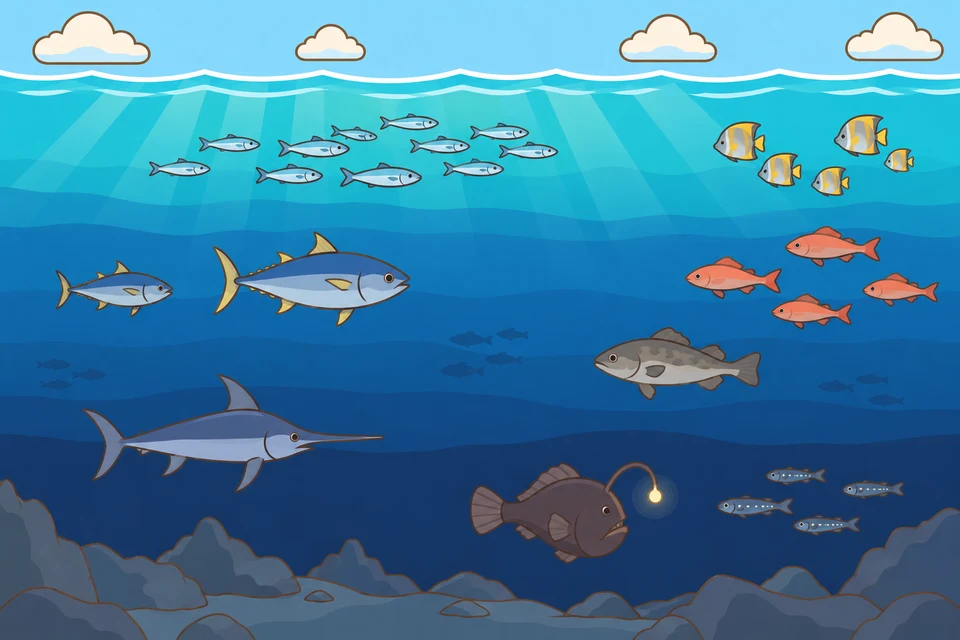
Sunlight is a mix of colours. Water absorbs red and orange light most strongly, so just a few metres down, reds look dull. Deeper still, yellow and green fade too, and blue travels furthest. That is why divers deep underwater see a mostly blue world.
This explains a neat trick: in the deep sea, red fish and shrimp look almost black, because no red light reaches them to bounce back. Many deep-sea animals are red or black, which works like an invisibility cloak against predators.
Scientists divide the ocean into layers by light. The top 200 metres or so is the sunlight zone, where seaweed and plant plankton can make food by photosynthesis. Below that it grows dimmer, and below about 1,000 metres no sunlight reaches at all. Murky water makes light fade even faster.
Where to see it in New Zealand
In Milford Sound / Piopiotahi in Fiordland, rain washes tannins from the forest into the fiord, staining the surface layer of fresh water the colour of tea. This layer blocks much of the sunlight, so it gets dim not far below the surface, and some deep-sea creatures can live unusually shallow.
Try it together
In a dark room, shine a torch through a large clear bottle of water. Then stir in a few drops of milk and watch the beam grow shorter and dimmer. The more milk, the less far the light reaches, just as murky water swallows sunlight faster.
Kids also ask
Why does the sea look blue?
Mainly because water absorbs more red light, leaving blue light to scatter back to our eyes. Reflections of the sky add a little. Water near the coast often looks green or brown because of plankton or mud.
Is the deep sea completely dark?
Below about 1,000 metres there is no sunlight, but it is not totally black. Many deep-sea animals make their own light to find food, attract mates or scare off predators, like tiny lamps in the night.
In the game, “Light at depth” is a nature card on Coral Undersea.
Your child finds this card by reaching the right place or meeting the right weather on the island, and lights it up by answering the question on the back. Tap the button below and the game shows your child which island it is on and how to find it. Mochi Isle is a browser learning game for ages 5 to 18; the main island and the daily lesson are free.
Find “Light at depth” on the island ↗ All cards from Coral Undersea