 Mochi Isle
 Snowflakes · Cedar HighlandsScience for kids
Why do snowflakes have six points?
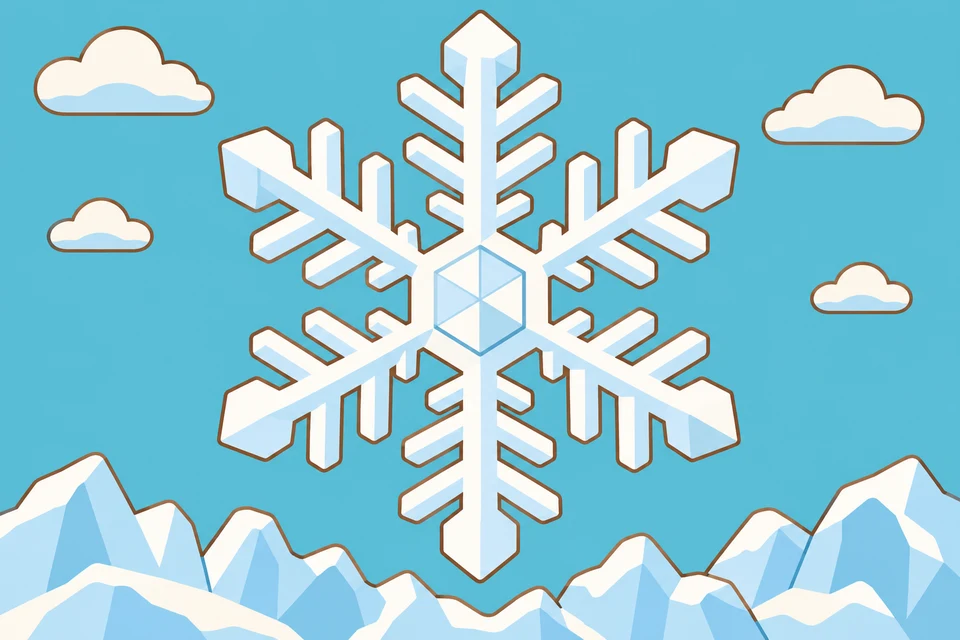
In short: Snowflakes begin when tiny droplets freeze into ice crystals inside clouds and then grow. Frozen water always lines up in a six-sided pattern, so snowflakes almost always have six points, and each grows so differently that no two look exactly alike.
How it works
Clouds are full of droplets far thinner than a hair. High in freezing air, a droplet can freeze around a speck of dust or pollen to make a tiny ice crystal. Water vapour in the cloud keeps sticking to the crystal, so it grows bigger and bigger until it is heavy enough to fall as a snowflake.
When water freezes, its molecules link hands in six-sided shapes, a bit like the cells of a honeycomb. A crystal that starts with this shape grows fastest at its six corners, so it sprouts six arms. That is why snowflakes almost always have six points or six sides.
As a snowflake falls, it drifts through air that is a little warmer or colder, wetter or drier, and each change makes its arms grow a different pattern. No two flakes take exactly the same path, so no two look exactly alike. Temperature also changes the style: some flakes look like stars, others like tiny columns.
Where to see it in New Zealand
In winter, snow often falls on the South Island's mountains and the volcanoes of the central North Island, where there are ski areas around Queenstown and on Ruapehu. Now and then, a bitterly cold southerly brings snow right down to sea level in southern cities such as Dunedin.
Try it together
When it snows, or on a trip to the snow, chill a piece of dark cloth or card in the freezer, then use it to catch falling flakes. Look quickly with a magnifying glass to find the six points. No snow? On a frosty morning, look at the ice crystals on the grass.
Kids also ask
Ice is clear, so why is snow white?
A pile of snow has millions of tiny ice surfaces. Sunlight bounces and scatters between them, and all the colours of light are sent back to your eyes together. All the colours mixed together look white.
Are no two snowflakes really the same?
For big, detailed snowflakes there are so many possible shapes that scientists think two identical ones are almost impossible. Very small, simple ice crystals, though, can look very alike.
In the game, “Snowflakes” is a nature card on Cedar Highlands.
Your child finds this card by reaching the right place or meeting the right weather on the island, and lights it up by answering the question on the back. Tap the button below and the game shows your child which island it is on and how to find it. Mochi Isle is a browser learning game for ages 5 to 18; the main island and the daily lesson are free.
Find “Snowflakes” on the island ↗ All cards from Cedar Highlands