 Mochi Isle
 Altitude & temperature · Cedar HighlandsScience for kids
Why is it colder at the top of a mountain?
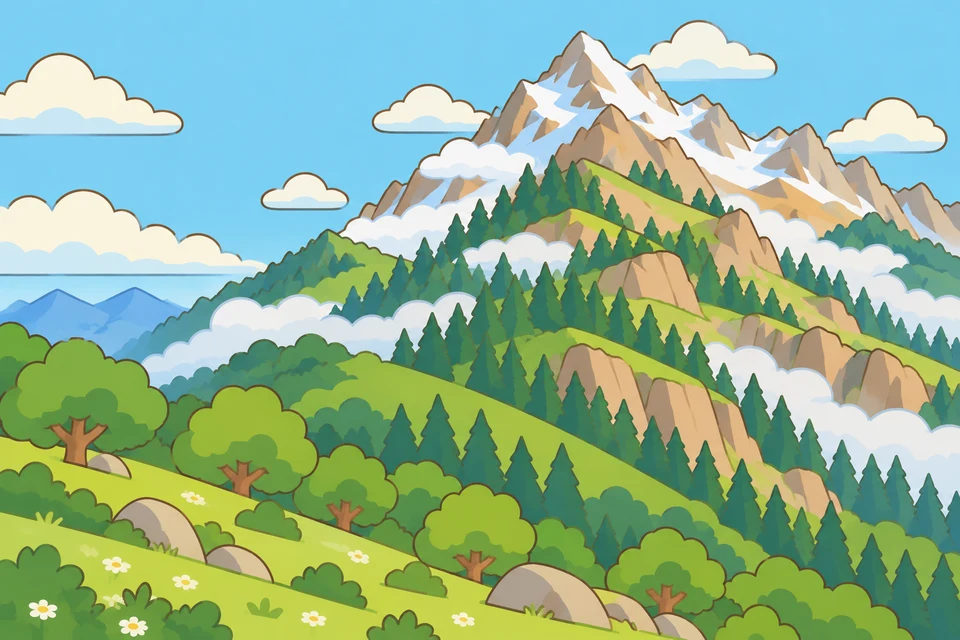
In short: The higher you climb, the colder it gets, by about 6 °C for every 1,000 metres. The sun mainly warms the ground, and the thin air high up is far from that warm ground and cannot hold on to the heat.
How it works
Most sunlight passes through the air without warming it much. Instead it warms the ground, and the ground then heats the air touching it, like a giant heater. Air high on a mountain is far from the big, warm lowlands and is thinner, so it holds less heat and stays colder.
Rising air also cools itself. Higher up, there is less air pressing on it, so it spreads out, and air that spreads out gets cooler. Think of the opposite: when you pump up a bike tyre, the squashed air makes the pump feel warm. Squeezed air warms up; spreading air cools down.
Try the maths: if it is 20 °C at the beach, it will be about 14 °C at 1,000 metres and only about 8 °C at 2,000 metres. That is why some high mountains keep snow on top even in summer. Always pack a warm layer when you head up a mountain.
Where to see it in New Zealand
Ruapehu, the North Island's highest mountain, is white with snow in winter and has ski fields on its slopes, while the shores of Lake Taupō are much milder. Even in summer, walkers on the Tongariro Alpine Crossing can need a warm jacket up high.
Try it together
Use a weather app to compare the temperature in a coastal city and a high mountain town at the same time. On a family drive up a big hill, read the car's outside temperature display, if it has one, at different heights and draw a little chart.
Kids also ask
Isn't a mountaintop closer to the sun, so shouldn't it be warmer?
Climbing a mountain brings you only a tiny bit closer to the sun compared with how far away it is. What really warms the air is the sun-heated ground, and mountaintops are far from the warm lowlands and surrounded by thin air.
Why is it harder to breathe high on a mountain?
The air is thinner, so every breath brings in less oxygen than at sea level. Your body has to breathe faster to keep up, which is why climbers feel tired and puffed and need to go slowly.
In the game, “Altitude & temperature” is a nature card on Cedar Highlands.
Your child finds this card by reaching the right place or meeting the right weather on the island, and lights it up by answering the question on the back. Tap the button below and the game shows your child which island it is on and how to find it. Mochi Isle is a browser learning game for ages 5 to 18; the main island and the daily lesson are free.
Find “Altitude & temperature” on the island ↗ All cards from Cedar Highlands