 Mochi Isle
 Cape · Coconut CoveScience for kids
Why are lighthouses often built on capes?
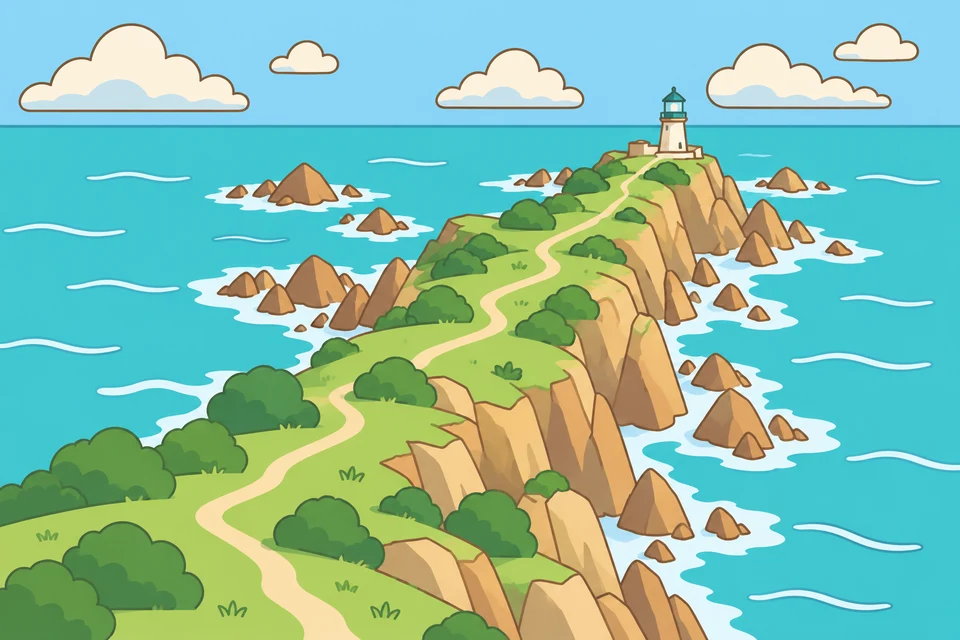
In short: A cape is a point of land sticking out into the sea. Because it juts out and is often high, a lighthouse there can be seen by ships far away, warning them of land and rocks so they can steer clear.
How it works
Many capes are made of hard rock. Waves wear away softer rock on either side into bays, but the hard rock is left behind, poking into the sea like a finger. Under the water near a cape there are often hidden rocks, and winds and currents swirl around it, so the waves can be big.
A lighthouse is a signpost for the sea. Built high on a cape, its light reaches far across the water. Each lighthouse flashes in its own pattern, perhaps one flash, perhaps two quick ones, so sailors can count the flashes and work out which lighthouse they are looking at and where their ship is.
Today ships use satellite navigation, but in fog, storms or when equipment fails, a lighthouse is still a trusty helper. Most lighthouses now run automatically, switching their lamps on by themselves when it gets dark, so keepers no longer need to live in them.
Where to see it in New Zealand
Near the top of the North Island, a white lighthouse stands at Cape Reinga / Te Rerenga Wairua. From there you can watch the Tasman Sea and the Pacific Ocean meet, their waves crashing together. For Māori it is a sacred place, where the spirits of the dead begin their journey home to Hawaiki.
Try it together
At night, switch off the lights and use a torch as your lighthouse. Cover and uncover it with your hand to make your own flash pattern, such as two flashes then a pause. Ask your family to be ship captains and guess which lighthouse you are.
Kids also ask
What is the difference between a cape and a peninsula?
A peninsula is a large piece of land with water on three sides, joined to the mainland on one. A cape is the narrow point that sticks out into the sea, and it is often found at the tip of a peninsula.
Why are the waves so rough around capes?
A cape sticks out into the path of wind and waves. Currents and waves get squeezed together and clash as they bend around it, and hidden rocks make waves rise suddenly, so the sea there is often wild.
In the game, “Cape” is a nature card on Coconut Cove.
Your child finds this card by reaching the right place or meeting the right weather on the island, and lights it up by answering the question on the back. Tap the button below and the game shows your child which island it is on and how to find it. Mochi Isle is a browser learning game for ages 5 to 18; the main island and the daily lesson are free.
Find “Cape” on the island ↗ All cards from Coconut Cove