 Mochi Isle
 Day & night · Mochi IsleScience for kids
Why do we have day and night?
In short: Earth spins like a top, turning once around its axis about every 24 hours. The side facing the sun has daytime, and the side turned away has night, so day and night keep taking turns.
How it works
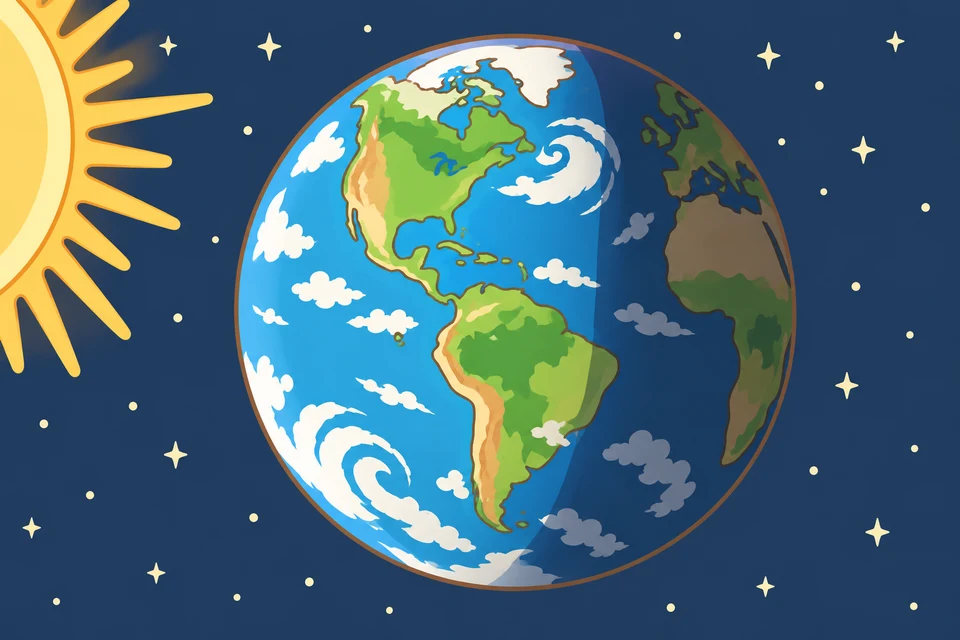
Imagine a giant invisible skewer running through Earth from the North Pole to the South Pole. This is its axis. Earth turns around it from west to east, making one full spin about every 24 hours, which is one day. The sun can only light up half of Earth at a time: that half has day, and the other half sits in Earth's own shadow, having night.
The sun seems to rise in the east and set in the west, but it is not really travelling around us. We are riding on the spinning Earth. It is like being on a merry-go-round, where the world around you seems to slide past even though you are the one moving.
Earth's axis is tilted. For part of the year our half of the planet leans towards the sun, so days are long and warm: that is summer. For the other part it leans away, and days are shorter and colder: that is winter. The tilt is why the length of the day changes through the year.
Where to see it in New Zealand
New Zealand is one of the first countries in the world to start each new day, and Gisborne on the East Coast is often called one of the first cities to see the sunrise. When it is midday here, it is the middle of the night in the United Kingdom. In summer, places further south such as Invercargill stay light later than Auckland.
Try it together
In a dark room, ask an adult to hold a torch as the sun. Put a small sticker on an orange or ball to stand for New Zealand. Turn it slowly and watch the sticker move into the light (morning) and back into the shadow (night).
Kids also ask
Why can't we feel Earth spinning?
Earth spins very smoothly, with no sudden speeding up or braking. We, the air, the buildings and the oceans all move along together, so our bodies cannot feel it, just like sitting in a smoothly flying plane.
Why are summer days longer than winter days?
Because Earth's axis is tilted. In summer our half of the planet leans towards the sun, so each spin carries us through more hours of sunlight. In winter it leans away, and the days are shorter.
In the game, “Day & night” is a nature card on Mochi Isle.
Your child finds this card by reaching the right place or meeting the right weather on the island, and lights it up by answering the question on the back. Tap the button below and the game shows your child which island it is on and how to find it. Mochi Isle is a browser learning game for ages 5 to 18; the main island and the daily lesson are free.
Find “Day & night” on the island ↗ All cards from Mochi Isle