 Mochi Isle
 Beach · Mochi IsleScience for kids
Where does beach sand come from?
In short: Sand is made of tiny bits of rock and shell. Rivers carry broken rock to the coast, and waves tumble and grind the pieces against each other over thousands of years until they become fine grains.
How it works
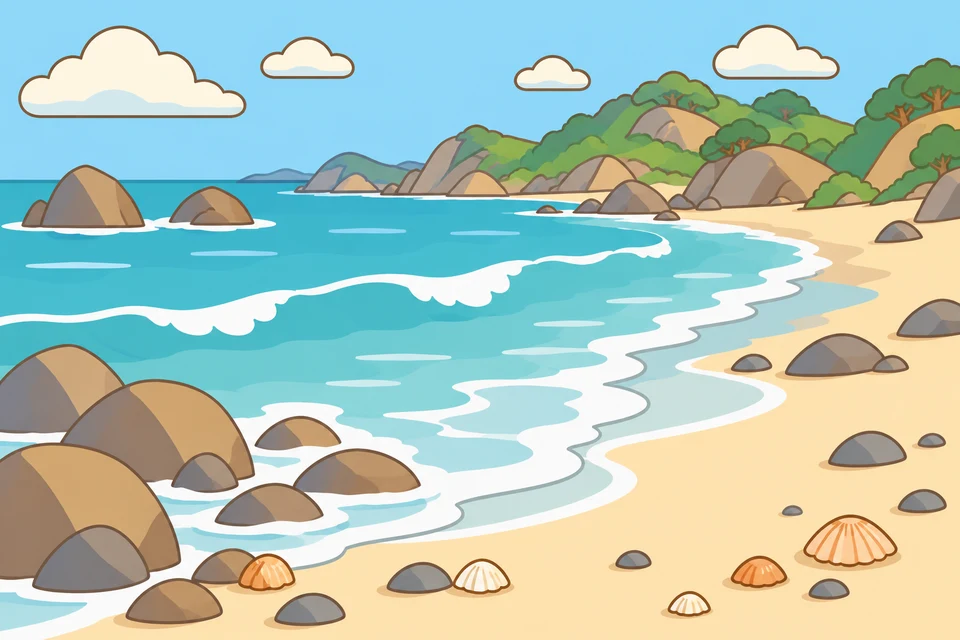
Rain, frost and tree roots slowly crack rocks in the hills, and rivers carry the broken pieces down to the coast. There, waves roll the stones back and forth thousands of times a day. They knock and rub against each other, their sharp corners wear off, and they get smaller and smaller until they are sand. Waves breaking up sea cliffs make sand too.
Sand also contains bits of shell, coral and sea urchin skeletons left by sea creatures. Different beaches have different colours. Many sands are mostly quartz, a tough mineral that is pale or golden. Tropical coral beaches are often dazzling white, and sand worn from volcanic rock is black.
Look at sand under a magnifying glass and you will see that the grains come in all sizes, colours and shapes, some glassy, some speckled, some pink or white. Each grain is a tiny piece of a rock or a shell, and it carries clues about where it came from.
Where to see it in New Zealand
Piha and other beaches on Auckland's west coast have black sand. It is rich in iron that comes from volcanic rock, and it gets very hot underfoot on a sunny day. In Abel Tasman National Park the beaches are golden, made from nearby granite rock that has broken down.
Try it together
At a black-sand beach with an adult, put a magnet inside a sealed plastic bag and drag it through the sand. Does a fuzzy layer of dark iron sand cling to it? At any beach, look at sand with a magnifying glass and hunt for bits of shell.
Kids also ask
Why are some beaches black?
Black sand usually comes from volcanic rock and contains dark, iron-rich minerals. Many beaches on the North Island's west coast are like this, so a magnet can pick up some of the grains.
Can waves take a beach away?
Yes, but often only for a while. Big storm waves can drag sand out to sea, and calmer waves slowly push it back. That is why the same beach can look wider or narrower at different times of year.
In the game, “Beach” is a nature card on Mochi Isle.
Your child finds this card by reaching the right place or meeting the right weather on the island, and lights it up by answering the question on the back. Tap the button below and the game shows your child which island it is on and how to find it. Mochi Isle is a browser learning game for ages 5 to 18; the main island and the daily lesson are free.
Find “Beach” on the island ↗ All cards from Mochi Isle