 Mochi Isle
 Fossils · Crescent DesertScience for kids
How do fossils form?
In short: Fossils are the remains or traces of living things from long ago. A plant or animal is quickly buried by mud or sand. Over millions of years the sediment turns to rock, and minerals slowly seep in and turn the remains to stone.
How it works
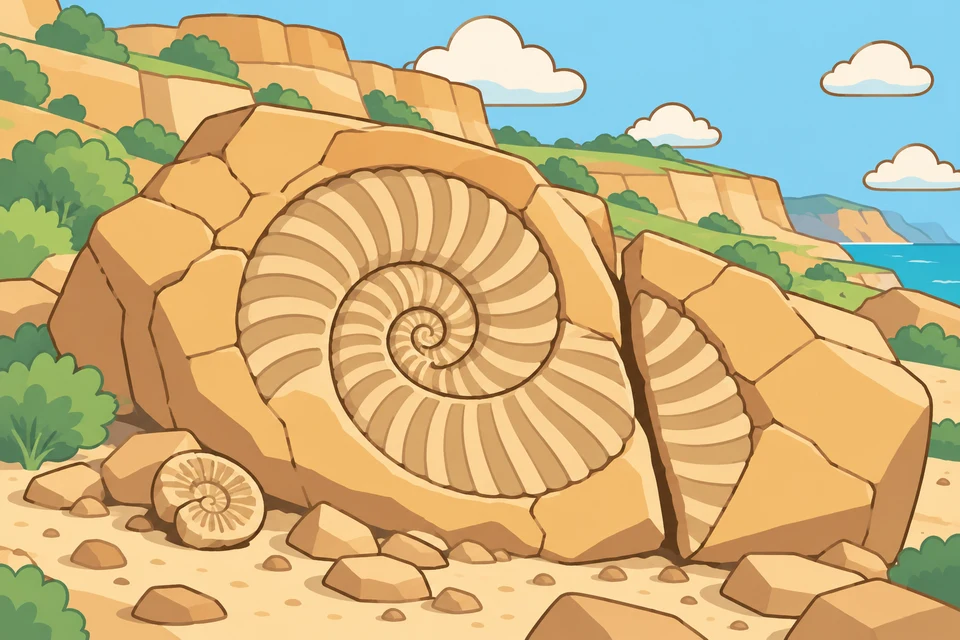
Most plants and animals rot away or get eaten after they die. Only a lucky few are buried quickly by mud or sand at the bottom of a river, lake or sea, which keeps the air out. Hard parts such as bones, teeth and shells have the best chance of being preserved.
More layers of mud and sand pile on top, pressing the lower layers until they harden into rock. Groundwater carrying dissolved minerals seeps through. The minerals fill tiny holes in bone or wood, or slowly replace it, until the remains have become stone in the very same shape.
Fossils aren't only bones. Footprints, leaf prints, burrows and even dinosaur eggs can be fossilised too. Much later, the land may be slowly lifted up, and wind and rain wear away the rock above, so the fossils are exposed and someone finds them.
Where to see it in New Zealand
At Curio Bay in the Catlins, in the far south of the South Island, you can see a petrified forest at low tide. Back when dinosaurs lived, a forest was buried by volcanic mudflows, and its tree stumps slowly turned to stone. Visit with an adult, watch the tide, and leave everything where it is.
Try it together
Press a shell or a tough leaf firmly into playdough, then lift it out carefully. The print left behind is like a mould fossil. Fill the print with a different colour of playdough, press it in, then lift it out. Now you have a cast fossil too.
Kids also ask
Are all fossils dinosaurs?
No. Fossils of shells, fish, plants and insects are far more common than dinosaur fossils. Many fossils are so small that you need a magnifying glass or even a microscope to see them.
How do scientists know how old a fossil is?
They look at which rock layer it is in, because deeper layers are usually older. They can also measure slow natural changes in certain substances in the rock, which work like a very slow clock.
Have dinosaur fossils been found in New Zealand?
Yes, but only a few, in places such as Hawke's Bay. New Zealand has many more fossils of sea creatures, including shells, and the bones of ancient penguins.
In the game, “Fossils” is a nature card on Crescent Desert.
Your child finds this card by reaching the right place or meeting the right weather on the island, and lights it up by answering the question on the back. Tap the button below and the game shows your child which island it is on and how to find it. Mochi Isle is a browser learning game for ages 5 to 18; the main island and the daily lesson are free.
Find “Fossils” on the island ↗ All cards from Crescent Desert