 Mochi Isle
 Hot days, cold nights · Crescent DesertScience for kids
Why are deserts hot in the day and cold at night?
In short: Desert air is dry and the sky is usually clear. By day, strong sunshine quickly heats the sand. At night there are no clouds or moist air acting like a blanket, and sand stores little heat, so warmth escapes fast.
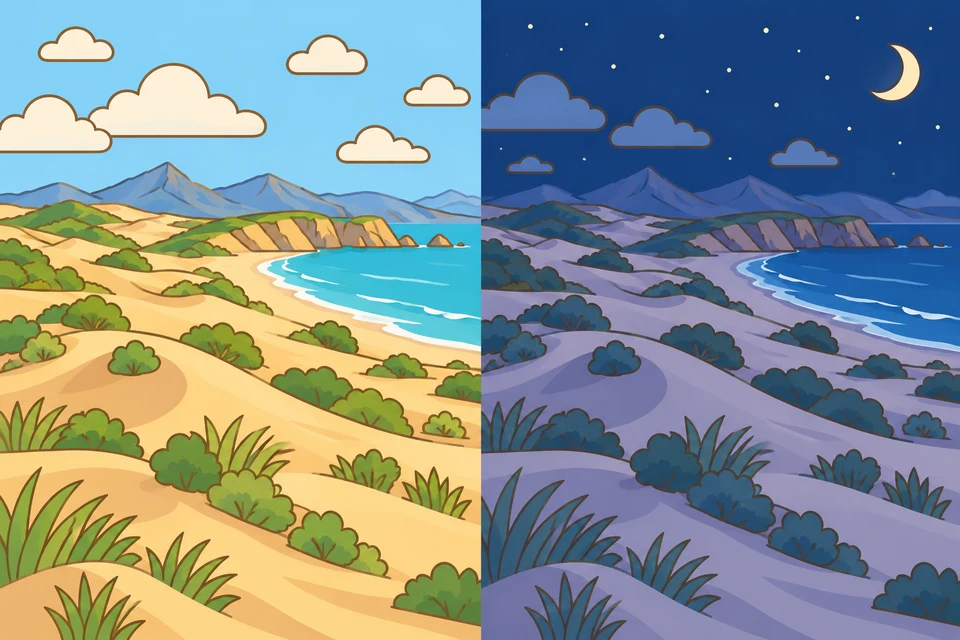
How it works
During the day, there are hardly any clouds in a desert to block the sun. Sunlight beats straight down on the sand, which heats up quickly. The ground can become too hot to walk on barefoot, and the air just above it gets very hot too.
At night, the ground gives off its heat towards the sky. On a cloudy night, clouds act like a blanket and send some of that heat back down, and water vapour in the air helps trap warmth too. Desert skies are clear and dry, so most of the heat simply escapes.
Sand and water behave very differently. Water can store a lot of heat, so it warms slowly and cools slowly. Sand heats fast and cools fast. That's why seaside places have mild nights, while in a desert you might sweat at lunchtime and need a blanket after dark.
Where to see it in New Zealand
New Zealand has no true deserts, but inland Central Otago, far from the sea, comes closest. Summer days are hot and sunny, while clear, calm nights cool down quickly and winter frosts are common. All over New Zealand, a clear winter night is more likely to bring frost than a cloudy one.
Try it together
On a sunny day, gently touch sand or a rock in the sun with the back of your hand, then touch a bowl of water left in the same spot. Which feels warmer? Check both again after sunset. Which one cooled down faster?
Kids also ask
How cold can a desert get at night?
It depends on the desert and the season. In some deserts, winter nights can drop close to freezing and frost may even form, even though the days are hot.
Why are cloudy nights warmer?
Clouds trap some of the heat the ground gives off and send it back down, like a blanket. On a clear night there's no blanket, so the heat escapes and frost forms more easily.
Are all deserts hot?
No. A desert is a place that gets very little rain or snow, not necessarily a hot place. Most of Antarctica gets so little that scientists count it as a desert, and it is icy cold.
In the game, “Hot days, cold nights” is a nature card on Crescent Desert.
Your child finds this card by reaching the right place or meeting the right weather on the island, and lights it up by answering the question on the back. Tap the button below and the game shows your child which island it is on and how to find it. Mochi Isle is a browser learning game for ages 5 to 18; the main island and the daily lesson are free.
Find “Hot days, cold nights” on the island ↗ All cards from Crescent Desert