 Mochi Isle
 Slopes and steps · Bamboo ValleyScience for kids
Why do hill paths have steps and zigzags?
In short: Steps cut a steep slope into many small rises, so each step lifts you only a little. A zigzag path is longer, but each part is gentler, which makes walking, pushing and carrying things easier and safer.
How it works
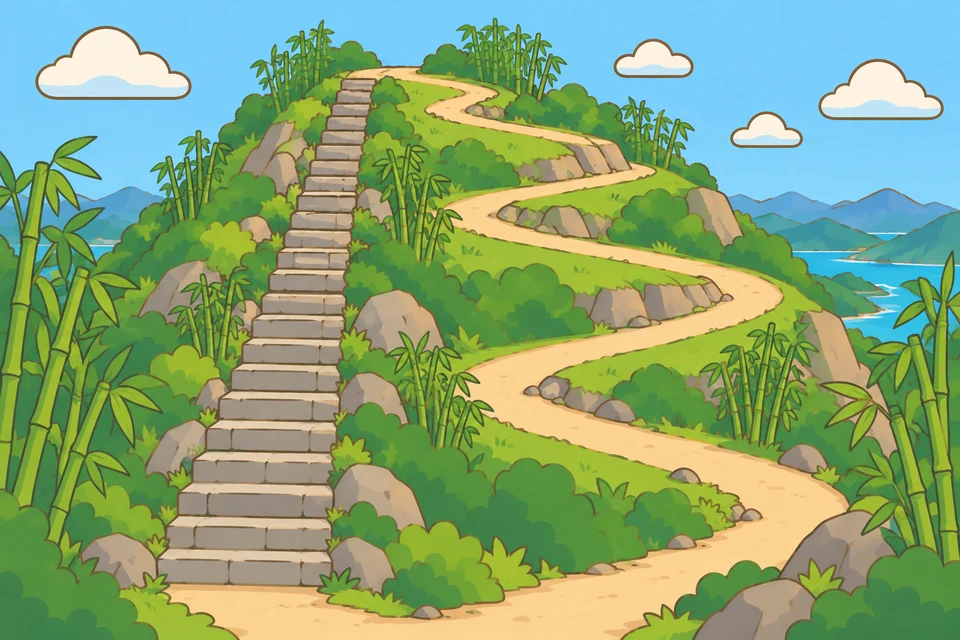
Imagine climbing straight up a steep bank of dirt: your feet slip and every step takes a big effort. Steps turn the slope into a row of flat ledges. Each one rises only a little, gives your foot somewhere level to stand, and helps you keep your balance.
A zigzag path uses the idea of a ramp, also called an inclined plane. To climb to the same height, the longer the path, the gentler the slope, and the less force each step needs. It is like pushing a heavy box onto a truck: a long plank is easier than a short one.
Steps and zigzags also protect the hillside. A track that goes straight up and down turns into a little stream channel when it rains, washing soil away. Well-built steps and bends with drains let rainwater run off slowly, so the track lasts longer.
Where to see it in New Zealand
The Tongariro Alpine Crossing has a steep climb called the Devil's Staircase, where steps and zigzags help walkers work their way up. On Auckland's Rangitoto Island, the last part of the summit track has wooden steps too. Both show how a hard climb can be split into manageable pieces.
Try it together
Stack some books and lean a short piece of stiff card against them to make a ramp. Tie a rubber band to a toy car and pull it up, watching how far the band stretches. Then use a longer card on the same stack and compare.
Kids also ask
Is a zigzag path really easier if it is longer?
To reach the same height, the total effort is about the same, but a zigzag spreads it over many more steps. Each step is easier, so you are less likely to slip or wear yourself out.
Why should every step be the same height?
When people use stairs, their feet get into a rhythm and expect each step to be the same. One step that is higher or lower than the rest can easily trip someone, so builders keep them even.
How should I walk down a steep path?
Your body tends to tip forward going downhill. Slow down, watch where you put your feet and take steps one at a time. Hold a rail if there is one, especially when it is wet or you are carrying something.
In the game, “Slopes and steps” is a nature card on Bamboo Valley.
Your child finds this card by reaching the right place or meeting the right weather on the island, and lights it up by answering the question on the back. Tap the button below and the game shows your child which island it is on and how to find it. Mochi Isle is a browser learning game for ages 5 to 18; the main island and the daily lesson are free.
Find “Slopes and steps” on the island ↗ All cards from Bamboo Valley